All Gorilla Families in Uganda
Uganda is one of the world’s most important destinations for mountain gorilla conservation and gorilla trekking. Travelers who visit the country can enter ancient tropical forests and spend time observing habituated mountain gorillas in their natural habitat. However, many visitors planning a safari want to know more than simply where gorilla trekking takes place. They want to understand the different gorilla families in Uganda, where each family lives, how the groups formed, which silverbacks lead them, and what makes each gorilla family unique.
Uganda’s mountain gorillas live mainly in Bwindi Impenetrable National Park and Mgahinga Gorilla National Park. Uganda Wildlife Authority identifies Bwindi’s four principal gorilla trekking sectors as Buhoma, Ruhija, Rushaga, and Nkuringo. Mgahinga offers another trekking experience within the Virunga mountain landscape.
The number and composition of gorilla families do not remain permanently fixed. Gorilla society constantly changes. Silverbacks challenge one another, young males leave their birth groups, females transfer between families, babies are born, older gorillas die, and established groups sometimes divide into new families. Meanwhile, conservation teams may begin habituating additional groups or dedicate certain families primarily to research.
Therefore, any list of all gorilla families in Uganda represents a particular period rather than a permanent record. Even the number of gorillas within a family can change from one month to another. For travelers, the most important information is the trekking sector assigned to their permit rather than a guarantee that they will visit one specific named family.
Nevertheless, understanding the different families makes a gorilla safari much more interesting. Every group has its own history, social structure, dominant males, females, juveniles, infants, and territory. Some families have been observed for decades, while others formed relatively recently.
This detailed guide explores the gorilla families associated with Uganda’s major trekking sectors and explains their histories, locations, characteristics, trekking experiences, conservation importance, and changing social structures.
gorilla trekking in bwindi
Mountain Gorillas in Uganda
Mountain gorillas belong to the eastern gorilla species and survive naturally in only a small part of Central and East Africa. Their habitat covers Bwindi Impenetrable Forest and the Virunga Massif shared by Uganda, Rwanda, and the Democratic Republic of Congo.
Uganda therefore holds an exceptionally important position in global mountain gorilla conservation.
Bwindi contains one of the major surviving mountain gorilla populations. Uganda Wildlife Authority reported in September 2026 that the most recently established benchmark for Bwindi remains 459 mountain gorillas from the 2018 census, while results from genetic analysis associated with the 2025/2026 survey were still awaiting release.
These gorillas do not all belong to tourism groups.
Many remain completely wild and never participate in tourism. Others have undergone a lengthy habituation process that gradually allows them to tolerate the carefully controlled presence of humans.
Tourists trek only groups approved for visitor experiences.
This distinction matters because travelers sometimes read the number of mountain gorillas in Uganda and divide it by the number of gorilla families. Gorilla populations are much more complex than that.
What Is a Gorilla Family?
A gorilla family is a social group that normally includes one or more adult males, several females, juveniles, sub-adults, and infants.
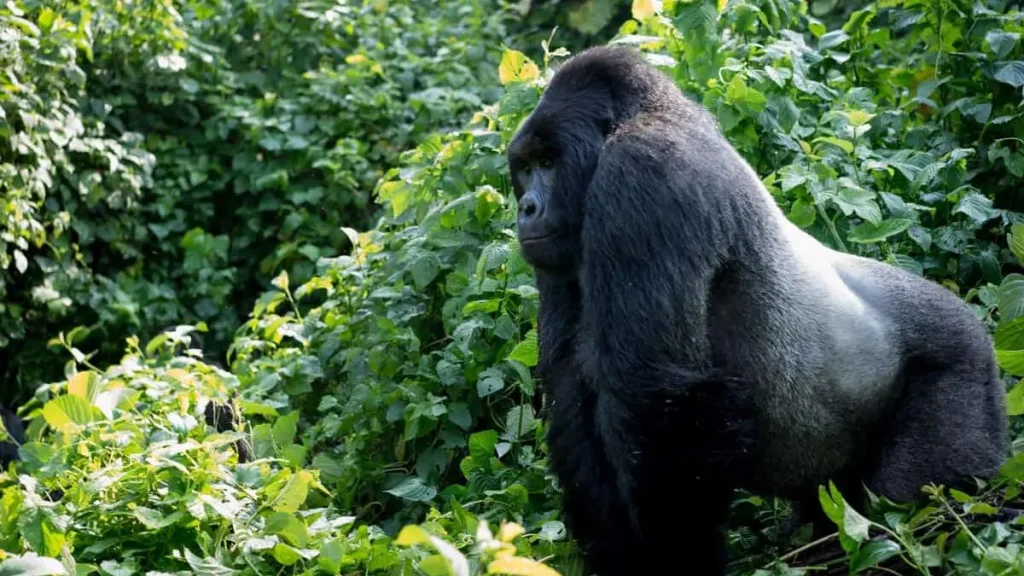
A mature male develops the silver-gray hair across his back that gives him the name silverback.
In many groups, one dominant silverback holds the main leadership position. He helps guide the family’s movements, protects members from threats, intervenes in conflicts, and maintains social order.
However, not every family follows the same structure.
Some groups contain several silverbacks. Younger adult males may remain within their birth group for a period, while others eventually leave and establish their own families.
Females can also transfer between groups.
These movements mean that gorilla family membership continually changes.
What Is Habituation?
Wild mountain gorillas naturally avoid or respond defensively to people. Before tourists can safely and responsibly observe a family, trained researchers and trackers gradually introduce the gorillas to controlled human presence.
This process is called gorilla habituation.
Habituation can take several years because conservation teams cannot rush the process. Rangers and researchers repeatedly visit the gorillas until the animals become sufficiently comfortable with predictable human presence.
Even after habituation, mountain gorillas remain completely wild.
Visitors cannot touch, feed, chase, or interact with them like captive animals. Instead, tourists follow strict instructions designed to protect both gorillas and humans.
Standard gorilla trekking in Uganda can involve approximately two to seven hours of searching, depending on the location of the assigned family. After trackers locate the gorillas, visitors normally receive about one hour of observation time.
showing the close social bonds and natural behavior of gorillas found in Bwindi and Mgahinga.
Gorilla Trekking Sectors
Bwindi is divided into four principal trekking sectors:
- Buhoma in the north.
- Ruhija in the east.
- Rushaga in the south.
- Nkuringo in the south.
Mgahinga Gorilla National Park forms a separate trekking destination near Kisoro within the Virunga Mountains.
The trekking sector matters considerably when arranging accommodation. Travelers should stay near the headquarters connected to their permit because driving between sectors can take several hours.
A traveler holding a Rushaga permit should not automatically book a lodge in Buhoma simply because both properties advertise themselves as being in Bwindi.
Good safari planning starts with permit availability and then matches accommodation to the correct trekking sector.
Buhoma Gorilla Families
Buhoma sits on the northern side of Bwindi Impenetrable National Park and has a special place in the history of gorilla tourism in Uganda.
Gorilla trekking began here before expanding to other parts of Bwindi.
Over time, several families have become associated with the Buhoma sector, including Mubare, Habinyanja, Rushegura, Katwe, Muyambi, and Binyindo.
Family structures can change, so current trekking allocation should always be confirmed with Uganda Wildlife Authority when permits are booked.
Mubare Gorilla Family
Mubare holds enormous historical importance because it became Uganda’s first mountain gorilla family opened for tourism in Bwindi.
Habituation began before the family eventually received visitors in the early 1990s. Tourism encounters with Mubare helped establish the model that would later support Uganda’s broader gorilla tourism industry.
The family took its name from the Mubare area where researchers initially encountered the group.
One of its most famous early leaders was the silverback Ruhondeza.
Ruhondeza became well known among researchers, guides, and visitors because of his long history within the family. As leadership changed, the group experienced the same natural transitions seen throughout gorilla society.
Over the years, Mubare has lost members, gained members, welcomed infants, and experienced changes in dominant leadership.
This unpredictability makes gorilla conservation fascinating. A family that contains many individuals during one period may become smaller following female transfers, male challenges, deaths, or family divisions.
Despite these changes, Mubare continues to represent the beginning of organized gorilla tourism in Uganda.
For travelers interested in conservation history, trekking a family connected to Uganda’s earliest gorilla tourism can add extra meaning to the experience.
Habinyanja Gorilla Family
Habinyanja is another long-established gorilla family in the Buhoma sector.
Its name relates to a local term connected with water or swampy areas where researchers encountered the gorillas during early monitoring.
Habinyanja became well known for its relatively large social structure during different periods of its history.
Like many large mountain gorilla families, however, Habinyanja eventually experienced separation.
The most important split led to the formation of another famous Buhoma family: Rushegura.
Family divisions occur naturally.
A younger or competing silverback may attract females and other individuals away from the original group. Alternatively, internal tensions can encourage gorillas to establish a separate social unit.
For researchers, such changes provide valuable insights into mountain gorilla behavior.
For tourists, Habinyanja can offer an interesting encounter because family groups containing different age classes often produce varied behavior during the observation hour.
Visitors may watch adults feeding while juveniles play nearby and the silverback monitors the group.
Rushegura Gorilla Family
Rushegura developed following a split from the Habinyanja family.
The group became one of Buhoma’s best-known tourism families and has sometimes ranged relatively close to areas around the park headquarters and nearby accommodation.
However, travelers should never assume that a particular family will always be easy to locate.
Mountain gorillas move according to food availability, social circumstances, weather, and other natural factors.
Therefore, even a family known for occasionally staying near accessible areas can move deeper into the forest.
Rushegura demonstrates how a new gorilla family can emerge from an established group and eventually become an important tourism family of its own.
Its history also helps visitors understand that the family names they see today may not represent the same family structures that existed twenty years ago.
Katwe Gorilla Family
Katwe became one of the newer habituated gorilla families associated with Buhoma.
The family added additional trekking capacity to the northern part of Bwindi while allowing conservation authorities to spread visitor pressure across more than the oldest groups.
Katwe’s development illustrates the careful way Uganda expands gorilla tourism.
Opening another family does not simply involve finding gorillas and immediately bringing tourists to them.
Teams must monitor the animals over an extended period, evaluate their response to people, understand their ranging behavior, and gradually prepare the group for regulated tourism.
Because gorilla-family compositions change continuously, the exact number of Katwe members can vary.
Therefore, visitors should avoid choosing a trek solely because an old website lists a particular number of infants or silverbacks.
What matters more is experiencing the family as it exists on the trekking day.
Muyambi Gorilla Family
Muyambi emerged as another relatively recent family within the Buhoma area.
The family has historical links with the older Mubare group.
Such relationships demonstrate how Uganda’s various gorilla families often form part of larger genealogical stories rather than functioning as isolated groups.
A silverback may grow up within one family, leave it, establish another unit, and eventually become the dominant male of a completely new tourism group.
As a result, visitors who learn the family histories begin to see connections across Bwindi.
Muyambi also helped increase the diversity of gorilla trekking opportunities available around Buhoma.
For tourists staying in northern Bwindi, the final family allocation normally depends on ranger planning rather than a personal guarantee.
Binyindo Gorilla Family
Binyindo is another group associated with the Buhoma trekking area.
Uganda Wildlife Authority publicly reported an encounter with the Binyindo family during a royal gorilla trek in April 2025, confirming the family’s presence as a recognized habituated group in Bwindi.
Binyindo represents the continuing development of Uganda’s gorilla tourism program.
As newer families become habituated, authorities can distribute visitors more effectively and create additional opportunities for trekking without concentrating everyone around only a few groups.
Like other families, Binyindo’s membership should not be treated as a permanently fixed number.
Births, transfers, deaths, and social changes can alter its structure.
Ruhija Gorilla Families
Ruhija lies on the eastern side of Bwindi and generally sits at higher elevation than some other trekking areas.
The sector attracts gorilla trekkers as well as birdwatchers because of its beautiful montane environment.
Families associated with Ruhija include Bitukura, Oruzogo, Mukiza, and the Kyaguriro lineage.
The Kyaguriro story deserves particular attention because research and group division have played major roles in its history.
Bitukura Gorilla Family
Bitukura ranks among Ruhija’s most established habituated families.
The group takes its name from the Bitukura area or river where researchers encountered it.
At various stages, Bitukura has contained multiple silverbacks, which makes the family particularly interesting from a social perspective.
A family with several mature males can maintain stability when relationships among those males remain well established.
However, silverback dynamics can also influence future splits.
Bitukura’s long habituation history has made it one of Ruhija’s central gorilla tourism families.
Travelers assigned to the group may trek through highland forest characterized by steep slopes, dense vegetation, and impressive views.
Again, trek difficulty depends more on where the family has moved on that particular day than on the family name alone.
Oruzogo Gorilla Family
Oruzogo is another well-known family in Ruhija.
Its name comes from local vegetation found within the area.
Over the years, the group has experienced births, departures, leadership changes, and the normal social transitions seen across mountain gorilla populations.
Visitors often find families with juveniles and infants especially engaging because younger gorillas can display active behavior.
They may climb small trees, wrestle, chase each other, imitate adults, or move curiously through the vegetation.
Nevertheless, no behavior can be guaranteed.
On some days, a family may spend most of the observation period feeding calmly or resting.
That unpredictability is part of experiencing truly wild gorillas.
Mukiza Gorilla Family
Mukiza developed following major social changes within the Kyaguriro family.
Sources describing the family’s history explain that Mukiza separated following leadership conflict in the older Kyaguriro lineage.
This split created another recognizable gorilla family in Ruhija.
The story provides an excellent example of how gorilla families form naturally.
Tourism authorities did not artificially divide the animals. Rather, gorilla social dynamics created a new group, after which researchers continued monitoring it.
Mukiza has subsequently become an important family within the Ruhija area.
Visitors interested in gorilla behavior may find such histories particularly fascinating because they show how leadership, competition, reproduction, and family loyalty influence group structure.
Kyaguriro Gorilla Family
Kyaguriro has one of the strongest research histories among Ruhija’s gorilla groups.
For years, researchers monitored the family closely, generating valuable information about mountain gorilla behavior and ecology.
The group later experienced important leadership changes and division.
Today, sources sometimes distinguish branches such as Kyaguriro A and Kyaguriro B, with different levels of research and tourism involvement. Recent accounts describe one branch as available for visitor encounters while another remains strongly connected with research.
This is one reason why websites can give different totals for the number of gorilla families in Uganda.
One source may count two branches separately, while another may refer simply to the broader Kyaguriro lineage.
For travelers, official permit allocation provides the most reliable practical information.
Rushaga Gorilla Families
Rushaga lies in southern Bwindi and contains one of the greatest concentrations of habituated and habituation-linked gorilla groups.
The sector has played an especially important role in expanding Uganda’s gorilla trekking opportunities.
Families associated with Rushaga include Nshongi, Mishaya, Bweza, Kahungye, Busingye, Bikingi, Rwigi, Mucunguzi, and Kutu, although the trekking or habituation status of individual groups can change over time.
This concentration gives Rushaga a particularly rich history of gorilla family splits.
Nshongi Gorilla Family
Nshongi became famous because it was once an exceptionally large habituated gorilla family.
The group took its name from the Nshongi area and river.
Large gorilla families rarely remain unchanged forever.
As males mature and competition develops, a major group may divide into several separate units.
That is exactly what happened within the broader Nshongi story.
Several important Rushaga families trace part of their history back to Nshongi.
Therefore, understanding Nshongi helps explain why southern Bwindi now contains so many different gorilla groups.
The family demonstrates how successful reproduction and complex social dynamics can eventually produce multiple new groups from one ancestral family.
Mishaya Gorilla Family
Mishaya formed after the silverback Mishaya separated from the larger Nshongi family.
The split represented an important moment in Rushaga’s gorilla history.
Mishaya established his own group by leaving the original family and attracting other members.
The resulting family experienced further changes in later years.
As with other gorilla groups, leadership changes and membership transfers affected the family’s structure.
Travel websites sometimes continue listing historical groups even when their present status has changed significantly.
For this reason, travelers should distinguish between a family that played an important role in Rushaga’s history and one currently guaranteed for everyday tourism.
Nevertheless, Mishaya deserves inclusion in any comprehensive account because of its major role in the development of Rushaga’s gorilla-family network.
Bweza Gorilla Family
Bweza also traces its origins to changes within the larger Nshongi lineage.
The silverback Bweza eventually established a separate group.
This division further reduced the original Nshongi family while producing another identifiable tourism family.
Bweza later became part of another important gorilla-family story when the silverback Mucunguzi separated and eventually formed his own group.
Therefore, the Bweza lineage illustrates several generations of changing gorilla social structure.
Visitors who understand these relationships can appreciate that a gorilla trek reveals only one moment in a much longer family history.
Kahungye Gorilla Family
Kahungye represents another important Rushaga family.
Like many established gorilla groups, it has experienced internal social changes over time.
The family later contributed to the formation of Rwigi when the silverback associated with that name separated and formed another group.
These changes show why conservation monitoring must continue every day.
Trackers do far more than locate gorillas for tourists.
They document births, illnesses, injuries, transfers, conflicts, disappearances, and changes in group leadership.
Without that long-term monitoring, much of what we know about individual gorillas and family history would disappear.
Busingye Gorilla Family
Busingye developed as another distinct family within the Rushaga sector.
Its history is connected to the wider Kahungye lineage.
The name Busingye is associated with the silverback that established the group.
Like other Rushaga families, Busingye occupies a landscape of steep hills, rainforest vegetation, valleys, and agricultural communities near the forest boundary.
Trekking the family can involve anything from a relatively manageable walk to a physically demanding forest hike depending on its daily location.
Therefore, visitors should prepare for the trek rather than relying on claims that one specific family is always easier than another.
Bikingi Gorilla Family
Bikingi, also sometimes spelled Bikyingi in tourism material, became another habituated group within Rushaga.
Its habituation history connects with gorillas associated with the broader Mishaya area and surrounding unhabituated individuals.
Recent sources continue to identify Bikingi as a Rushaga gorilla group used for trekking.
The family has experienced major leadership changes, including the loss of an earlier dominant silverback.
When a dominant male disappears or dies, a gorilla family can change quickly.
Some females may remain together, others may transfer, and rival males may attempt to take control.
These events can completely reshape a family within a relatively short period.
Bikingi therefore represents another fascinating example of the fluid nature of mountain gorilla society.
Rwigi Gorilla Family
Rwigi emerged following a separation from Kahungye.
The dominant male established a new group with gorillas that moved away from the original family.
Sources continue to list Rwigi among Rushaga’s recognized habituated groups.
Its story resembles many other mountain gorilla family formations.
A silverback reaches maturity, social competition develops, and eventually a new family unit emerges.
Over time, births and additional female transfers can increase the size of the new group.
The process contributes naturally to the complex network of gorilla families found throughout Bwindi.
Mucunguzi Gorilla Family
Mucunguzi is another more recently established family associated with Rushaga.
Its history links strongly with Bweza.
The name Mucunguzi is commonly translated as savior.
Accounts of the group’s formation describe the silverback leaving his previous family and eventually establishing a new unit.
Mucunguzi’s formation provides another example of how individual male gorillas can shape the future structure of Bwindi’s habituated population.
Visitors sometimes become particularly interested in dominant silverbacks because their leadership stories resemble long family biographies.
However, the females also play an essential role because their decisions to remain, transfer, or reproduce significantly influence group stability.
Kutu Gorilla Family
Kutu has been associated with gorilla habituation activity in the Rushaga region.
Some sources describe the family within the context of the Gorilla Habituation Experience rather than standard trekking.
This distinction matters.
A fully habituated tourism group and a family undergoing or recently completing habituation may be managed differently.
The Gorilla Habituation Experience allows visitors to spend time in the forest alongside researchers and trackers while a family becomes accustomed to human presence.
Availability and family designation can change, so travelers interested specifically in habituation should confirm the currently assigned group when booking rather than assuming Kutu will always be the family visited.
Nkuringo Gorilla Families
Nkuringo lies in southern Bwindi and offers dramatic highland scenery.
The terrain can become challenging, but many travelers consider the landscape among the most beautiful parts of the park.
Major families associated with Nkuringo include Nkuringo, Bushaho, Christmas, and Posho.
Like Rushaga, Nkuringo provides particularly interesting examples of family splits and leadership transitions.
Nkuringo Gorilla Family
The Nkuringo family gave the trekking sector its name and became the first major habituated tourism family in this part of Bwindi.
The group has experienced several famous leadership transitions.
One of its best-known silverbacks in recent history was Rafiki.
The family attracted international attention when Rafiki died in 2020, an event that demonstrated how deeply individual gorillas become connected with conservation staff, local communities, and travelers.
After major leadership changes, gorilla families must reorganize.
A new dominant male may take control, membership may shift, and social relationships can change.
Despite such events, the Nkuringo lineage continues to represent one of southern Bwindi’s most important gorilla histories.
Bushaho Gorilla Family
Bushaho formed partly through movements involving members connected to the Nkuringo family.
The group eventually developed into a separate recognized family.
Its dominant leadership and membership have changed over time as new births and transfers occurred.
Bushaho became another valuable trekking group within southern Bwindi and helped expand visitor opportunities beyond the original Nkuringo family.
Its history again demonstrates why describing gorilla groups as permanently separate entities can be misleading.
Many families share biological and historical connections.
Christmas Gorilla Family
The Christmas family takes its name from the silverback Christmas.
The silverback himself received the name because of the timing associated with his birth.
International Gorilla Conservation Programme records identify Christmas as a habituated group in the Nkuringo tourism sector.
The family’s development added another tourism group to southern Bwindi.
As with the other families, its composition changes naturally.
Travelers who read an online article listing eight members should understand that the number may be different when they eventually arrive.
Births alone can quickly change family totals, while transfers and deaths can reduce them.
Posho Gorilla Family
Posho represents one of the newer habituation developments associated with Nkuringo.
The unusual name relates to the common East African maize meal known as posho.
Different sources have described the group at different stages of habituation and tourism readiness. Some earlier reports indicated that habituation had finished but the group had not yet entered the standard permit booking system.
More recent tourism sources increasingly include Posho among Nkuringo’s habituated families.
This changing status demonstrates why tourists should check current Uganda Wildlife Authority allocation rather than relying exclusively on an article published several years earlier.
Mgahinga Gorilla Families
Mgahinga Gorilla National Park provides Uganda’s second main mountain gorilla trekking destination.
The park forms part of the Virunga Massif and borders the gorilla landscapes of Rwanda and the Democratic Republic of Congo.
Uganda Wildlife Authority’s current gorilla trekking information indicates that Mgahinga issues around eight trekking permits per day, reflecting its much smaller tourism capacity compared with Bwindi.
The family most consistently and officially associated with standard tourism in Mgahinga is Nyakagezi.
Nyakagezi Gorilla Family
Nyakagezi ranks among Uganda’s most fascinating gorilla families.
Unlike many Bwindi groups, Nyakagezi lives within the Virunga mountain ecosystem.
The family has historically moved across international borders because gorillas do not recognize political boundaries.
Mountain forests continue from Uganda into Rwanda and the Democratic Republic of Congo, allowing wildlife to move naturally across the wider landscape.
The International Gorilla Conservation Programme identifies Nyakagezi as a habituated Mgahinga group and records its long history of tourism and conservation monitoring.
The family has also become famous for containing several mature males.
Multi-male gorilla families create fascinating social structures because adult males maintain relationships within the same group rather than every mature silverback immediately leaving.
Nyakagezi’s relatively restricted tourism capacity means travelers interested in Mgahinga should organize permits early.
What About Hirwa?
Travelers researching Mgahinga may also encounter the name Hirwa.
Hirwa is a Virunga mountain gorilla family that has moved across national boundaries at different times.
Because transboundary gorilla groups can migrate between Rwanda, Uganda, and the Democratic Republic of Congo, their location can change.
Some tourism websites currently describe Hirwa as associated with Mgahinga, while Uganda Wildlife Authority’s own public gorilla-tracking information still indicates approximately eight permits per day for Mgahinga, which corresponds with one standard tourism group.
Therefore, travelers should not assume that Hirwa represents a permanently bookable second Mgahinga family.
The most reliable approach is to confirm the currently available group through official permit allocation.
Why Gorilla Family Numbers Differ Online
Anyone researching all gorilla families in Uganda will quickly notice that different websites give different totals.
One page may claim Uganda has 20 families.
Another may list 21, 22, 24, or 25.
This does not always mean one source is deliberately incorrect.
Several factors explain the differences.
First, gorilla families divide naturally.
Second, some groups remain dedicated primarily to research.
Third, families can enter or leave habituation programs.
Fourth, a group may complete habituation before Uganda Wildlife Authority adds it to regular tourism allocations.
Fifth, websites sometimes continue listing historic groups that have since changed significantly.
Finally, certain sources count branches of one lineage separately.
For these reasons, a responsible travel article should explain the complexity instead of claiming that one permanent number will remain correct forever.
Families Change Naturally
Mountain gorillas live dynamic social lives.
A dominant silverback cannot control every aspect of his family’s future.
Adult females can leave.
Young males can challenge leaders.
Competing silverbacks can attack groups.
Infants are born.
Older members die.
Disease and injury can also influence group structure.
Therefore, a family of sixteen gorillas this year may contain thirteen or nineteen members later.
Visitors should treat exact membership numbers as snapshots.
Silverback Leadership
Dominant silverbacks often become the most recognizable members of gorilla families.
Their large size makes them visually impressive, but their role extends far beyond physical strength.
A leader influences movement, protects family members, responds to threats, and mediates social interactions.
However, leadership eventually changes.
A younger male may challenge an older silverback.
Sometimes the transition happens gradually. At other times, serious conflict occurs.
A defeated silverback may become solitary, remain as a subordinate male, or eventually establish another family.
These events often create the origins of new gorilla groups.
Female Transfers
Female gorillas also shape family development.
Females can leave one group and join another, especially when they encounter attractive reproductive or social opportunities.
This behavior contributes to genetic diversity.
It also means a family can change significantly without an obvious split.
Researchers therefore identify individual gorillas carefully through features such as nose prints and other physical characteristics.
Gorilla Births
Few events generate as much excitement among conservation teams as a new gorilla birth.
Infants increase hope for the long-term survival of the population.
New mothers keep their babies close during the early months, and visitors may see tiny infants clinging tightly to their mothers’ bodies.
As the young gorillas grow, they become increasingly adventurous.
Juveniles often provide some of the most entertaining moments during a trek because they climb, tumble, wrestle, and imitate older family members.
However, visitors should remain quiet and follow ranger instructions regardless of how playful the animals appear.
Which Gorilla Family Is Best?
There is no single objectively best gorilla family in Uganda.
Every group can provide an extraordinary encounter.
A large family may give visitors many different gorillas to observe.
A smaller group may produce a calmer and more intimate-feeling experience.
A family with several infants can appear especially active.
Another family may have an impressive dominant silverback.
However, none of these conditions can be guaranteed.
Wild animals determine what visitors see.
For that reason, travelers should focus more on the overall trekking destination, accommodation, fitness level, safari route, and permit availability than on trying to secure one particular family.
Can You Choose a Gorilla Family?
Travelers normally book a gorilla trekking permit for a particular destination or sector rather than receiving a guaranteed named family months in advance.
Rangers organize trekking groups according to operational factors.
These can include the gorillas’ latest known locations, visitor fitness, group organization, family movements, and conservation requirements.
Travelers may sometimes communicate preferences, but they should not treat a specific family request as guaranteed.
Therefore, the smartest strategy involves choosing the right trekking sector and allowing the rangers to manage the final allocation.
How Many People Visit a Family?
Uganda carefully limits daily tourist access to habituated gorilla families.
The purpose is to reduce disturbance and disease risk.
Smaller trekking groups also create a more controlled wildlife experience.
During the briefing, rangers explain the rules visitors must follow.
Trekkers then enter the forest with guides and trackers.
Once they locate their assigned family, the regular gorilla tracking experience provides approximately one hour with the animals.
The limited encounter helps balance tourism with conservation.
Gorilla Trekking Permits
Every tourist participating in standard gorilla trekking requires a valid permit.
Foreign non-residents should arrange permits through the approved booking process, commonly with a properly licensed Ugandan tour operator.
Travelers should book well in advance when visiting during popular months.
Demand can become particularly strong during holiday periods and traditional drier seasons.
Permit prices also change over time.
Therefore, travelers should confirm the tariff applying to their exact travel date rather than relying on an old article.
Bwindi or Mgahinga?
Both parks can deliver exceptional gorilla encounters.
Bwindi provides more trekking sectors and more habituated families.
Therefore, travelers normally find greater accommodation variety and more route options there.
Mgahinga provides a different atmosphere.
The Virunga volcanoes dominate the landscape, while bamboo and montane ecosystems add a dramatic mountain setting.
Travelers staying near Kisoro can also combine gorilla trekking with golden monkey tracking and other activities.
Neither park guarantees a better gorilla encounter.
The choice depends on permit availability, itinerary design, travel time, and personal interests.
Buhoma or Ruhija?
Buhoma often works particularly well for travelers connecting with Queen Elizabeth National Park through Ishasha.
It also provides a wide range of accommodation.
Ruhija sits at higher elevation and offers beautiful forest and mountain scenery.
Birdwatchers frequently appreciate the area.
Travelers should consider lodge availability, road route, trekking permit availability, and the rest of their safari itinerary.
The identity of a single gorilla family should rarely become the only factor.
Rushaga or Nkuringo?
Rushaga and Nkuringo both lie in southern Bwindi.
Travelers often approach them through Kisoro.
Rushaga provides access to several gorilla groups and has played an important role in the Gorilla Habituation Experience.
Nkuringo offers dramatic scenery and challenging terrain.
Both sectors connect well with destinations such as Lake Mutanda, Kisoro, and Mgahinga.
Again, the best option depends on the entire safari plan.
Trekking Difficulty
Gorilla trekking difficulty changes from day to day.
One family may remain relatively close to the starting area in the morning and move several kilometers deeper into the forest the following day.
Rain also affects trail conditions.
Mud can make steep paths difficult, while dry conditions improve grip.
Visitors should therefore prepare for several hours of walking even when they hope for an easier trek.
Strong walking shoes, long trousers, rain protection, water, gloves, and a porter can significantly improve the experience.
Hire a Porter
Hiring a porter remains one of the most useful decisions during a gorilla trek.
Porters can carry cameras, drinking water, rain jackets, snacks, and other equipment.
More importantly, they can offer a steadying hand on steep or muddy terrain.
Using porter services also creates direct local employment.
Communities surrounding gorilla parks carry many conservation responsibilities, so tourism becomes more sustainable when local residents receive meaningful economic benefits.
Even fit visitors can benefit from hiring a porter.
Best Time for Gorilla Trekking
Uganda offers gorilla trekking throughout the year.
Rain can fall during any month because Bwindi and Mgahinga are mountain forest environments.
Periods with comparatively less rainfall can produce easier trail conditions.
However, the forest remains green because it receives substantial moisture.
Travelers should therefore carry waterproof clothing regardless of travel month.
The best time ultimately depends on permits, accommodation, airfare, overall safari route, and personal schedule.
Photographing Gorilla Families
Photography forms an important part of most gorilla encounters.
However, visitors should avoid spending the full hour looking through a camera.
Taking several photographs and then watching the gorillas directly often creates a richer experience.
Forest photography can also become difficult because light levels change rapidly.
Travelers should understand their cameras before trekking.
A fast lens, spare battery, enough memory, and suitable rain protection can help.
Most importantly, visitors must follow current ranger instructions concerning flash photography and distance.
Gorilla Trekking Etiquette
Every trekking group receives a briefing before entering the forest.
Visitors should listen carefully because gorilla-tourism rules protect endangered animals.
Trekkers must follow instructions regarding distance, noise, food, photography, illness, and movement around the gorillas.
Visitors should never attempt to touch an animal.
Even when a curious juvenile approaches, the ranger controls the situation.
Mountain gorillas remain powerful wild animals despite their habituation.
Respecting their space remains essential.
Health and Gorilla Families
Humans and gorillas share biological similarities, which means certain diseases can pass between the two.
Therefore, health precautions form a crucial part of gorilla tourism.
Travelers who become seriously unwell close to their trekking date should inform their guide.
Nobody wants to miss a long-planned gorilla trek.
However, protecting an endangered population must remain more important than one visitor experience.
Visitors should also maintain good hygiene and follow any current health guidance issued by Uganda Wildlife Authority.
Gorilla Conservation
Uganda’s gorilla families represent far more than tourism attractions.
They form part of a major conservation program involving rangers, researchers, veterinary professionals, tourism authorities, local communities, conservation organizations, and international partners.
Long-term monitoring helps conservation teams understand each family.
Rangers know individual gorillas, family relationships, ranging areas, and recent events.
This information allows them to identify unusual behavior or health concerns.
Uganda Wildlife Authority reported in September 2026 that Bwindi’s mountain gorilla population had grown from roughly 300 recorded in the early 1990s to the 459 individuals established by the 2018 census, while newer genetic-analysis results were still pending release.
The long-term improvement highlights the importance of continued habitat protection and conservation investment.
Tourism and Communities
Gorilla conservation cannot succeed without communities living around the parks.
People near Bwindi and Mgahinga interact with the conservation landscape every day.
Tourism provides jobs through guiding, accommodation, agriculture, crafts, transport, porter work, cultural tourism, and other services.
Travelers contribute more effectively when they use responsible operators, employ local porters, purchase genuine local products, and treat residents respectfully.
Conservation becomes stronger when wildlife survival creates meaningful economic value for surrounding communities.
Why Family Histories Matter
Learning the names and histories of Uganda’s gorilla families transforms the trekking experience.
Without this background, a visitor may simply see several gorillas sitting in vegetation.
With greater understanding, the same visitor begins to recognize a complex society.
The silverback becomes a leader with a history.
A female may have transferred from another family.
A juvenile may represent the next generation of an important lineage.
Another male may eventually leave and form a completely new group.
Suddenly, the forest becomes a living family history rather than simply a wildlife attraction.
Gorilla Families and Research
Research has played a major role in protecting mountain gorillas.
Scientists study behavior, reproduction, genetics, habitat use, health, social relationships, and population trends.
Groups such as Kyaguriro have contributed particularly valuable long-term research.
Researchers also rely on consistent identification.
Individual mountain gorillas have unique nose-print patterns, much like fingerprints in humans.
Recognizing individuals allows teams to maintain detailed histories across many years.
Those records become vital when evaluating births, deaths, family changes, and long-term conservation trends.
Gorilla Habituation Experience
Uganda also offers the Gorilla Habituation Experience in Bwindi.
This activity differs from standard trekking.
Instead of visiting a fully habituated tourism family for the regular one-hour encounter, participants accompany researchers and trackers during a longer habituation-focused experience.
The activity provides insight into how gorillas gradually become accustomed to human observers.
Because the families used for habituation can change, visitors should confirm the currently designated group while booking.
Travelers should also remember that partially habituated gorillas may behave differently from long-established tourism families.
Planning a Gorilla Safari
The first step involves selecting approximate travel dates.
Next, travelers should check gorilla permit availability.
After identifying the trekking sector, they can choose suitable accommodation nearby.
Only then should the wider itinerary be finalized.
For example, a Buhoma permit can connect naturally with Queen Elizabeth National Park.
A Rushaga or Nkuringo permit can connect conveniently with Kisoro, Lake Mutanda, Lake Bunyonyi, or Mgahinga.
Good route planning reduces unnecessary driving and creates more time for actual safari experiences.
Combine Gorilla Trekking with Wildlife
Uganda offers many opportunities beyond mountain gorillas.
Travelers can combine Bwindi with Queen Elizabeth National Park for elephants, buffaloes, antelopes, boat safaris, and the famous Ishasha tree-climbing lions.
Kibale National Park adds chimpanzee trekking.
Murchison Falls National Park adds savannah wildlife and dramatic Nile scenery.
Mgahinga offers golden monkey tracking and mountain experiences.
Lake Bunyonyi and Lake Mutanda provide opportunities to relax after trekking.
Therefore, visitors traveling long distances to Uganda should consider building a broader safari around the gorilla experience.
Gorilla Families and Children
Families traveling with children should confirm the current minimum-age requirement for gorilla trekking before booking.
If some children are too young for the trek, a tour operator can arrange alternative activities.
These may include community visits, nature experiences, sightseeing, or lodge activities depending on the destination.
Parents should communicate children’s ages during the first planning stage rather than after permits have been arranged.
Accommodation Near Gorilla Families
Travelers do not book accommodation according to the exact named family.
Instead, they choose a lodge near the relevant trekking sector.
Buhoma contains accommodation ranging from simple properties to luxury forest lodges.
Ruhija provides quieter mountain lodges.
Rushaga and Nkuringo offer a growing collection of budget, mid-range, and luxury choices.
Mgahinga visitors can stay around the park or near Kisoro.
Sector location matters more than the lodge’s marketing description.
Gorilla Family Allocation
Many travelers arrive at the park hoping to trek a particular famous family.
However, allocation decisions happen within the broader park-management system.
Rangers understand where each group was located recently and what route may be appropriate.
Therefore, visitors should remain flexible.
A traveler who wanted Mubare but receives Habinyanja can still have an extraordinary experience.
Every gorilla family offers natural behavior that cannot be repeated anywhere else.
Do Gorillas Recognize Rangers?
Habituated mountain gorillas become accustomed to familiar human presence.
Trackers and researchers spend enormous amounts of time monitoring them.
Although visitors should avoid interpreting gorilla behavior too much through human emotions, long-term familiarity plays an important role in the habituation process.
Gorillas learn that the predictable presence of trained teams does not represent a threat.
This gradual trust makes carefully managed tourism possible.
However, habituation never means domestication.
The animals remain wild.
Can Gorilla Families Fight?
Yes.
Conflict occurs naturally within gorilla society.
Silverbacks may challenge each other over females, territory, leadership, or access to a group.
Such confrontations can cause injuries and sometimes deaths.
Fights can also lead to family divisions.
Many of Uganda’s current gorilla groups exist partly because a silverback separated from another family following competition.
Although these events can appear dramatic, they form part of natural gorilla behavior.
Conservation teams normally allow natural social processes to occur unless exceptional circumstances require intervention.
Why Gorillas Leave Families
Male gorillas often leave their birth group as they approach maturity.
Some live alone for a period before acquiring females and forming a new group.
Others may remain in multi-male families.
Females also move between groups.
These transfers help maintain genetic diversity and reshape family structures.
Therefore, a visitor returning to Uganda several years later may discover that familiar individual gorillas now live in different families.
Baby Gorillas
Baby gorillas attract enormous interest because their behavior often appears playful and curious.
During their earliest stages, infants remain closely attached to their mothers.
As they grow, they begin exploring their surroundings.
They climb vegetation, interact with siblings and juveniles, and gradually learn feeding behavior.
However, infant survival remains a serious conservation concern.
Researchers closely monitor mothers and babies while avoiding unnecessary interference with natural processes.
Every successful birth contributes to the future of the population.
Silverbacks
Adult male mountain gorillas rank among the most physically impressive primates on Earth.
Their enormous shoulders, long arms, broad chests, and silver-colored backs make them instantly recognizable.
Nevertheless, strength represents only part of their role.
A successful dominant male needs social awareness.
He maintains relationships with females, protects infants, responds to rival males, and helps stabilize the group.
When visitors watch a silverback calmly feeding beside his family, they are observing the result of a complex social system rather than simply a large animal resting in the forest.
What Visitors Usually See
Every gorilla trek differs.
Visitors may encounter a family feeding together.
They may watch a silverback sleeping while juveniles play nearby.
A mother may carry an infant.
Young males may wrestle.
A gorilla may climb into vegetation and disappear almost completely.
Heavy foliage sometimes makes photography challenging.
However, the unpredictability is part of the experience.
A gorilla trek does not resemble a staged wildlife show.
Visitors enter the animals’ natural environment and observe whatever happens during that hour.
Responsible Gorilla Tourism
Responsible tourism protects Uganda’s gorilla families for future generations.
Visitors should follow park regulations, maintain appropriate distance, avoid littering, never feed wildlife, and respect local communities.
Travel companies also carry responsibility.
Operators should use legitimate permits, realistic itineraries, properly maintained vehicles, knowledgeable guides, and ethical tourism practices.
Travelers can ask questions before booking.
Transparency helps protect both tourists and conservation systems.
Frequently Asked Questions
How many gorilla families are in Uganda?
There is no permanent number because gorilla families split, merge, change status, and enter or leave habituation programs.
Tourism websites frequently publish different totals for this reason.
Uganda Wildlife Authority’s current public information confirms four major trekking sectors in Bwindi—Buhoma, Ruhija, Rushaga, and Nkuringo—and gorilla trekking in Mgahinga.
Travelers should therefore confirm currently available tourism groups when booking permits rather than relying on an old fixed number.
Where are gorilla families found in Uganda?
Habituated mountain gorilla families used for tourism are found in Bwindi Impenetrable National Park and Mgahinga Gorilla National Park.
Bwindi contains the largest number of trekking groups.
Which sector has the most gorilla families?
Rushaga has historically contained one of the greatest concentrations of habituated and habituation-related groups.
However, family status changes, so current permit availability provides the most useful guide.
Which is the oldest habituated gorilla family?
Mubare holds special historical importance as the first family opened for gorilla tourism in Uganda.
Which gorilla family is in Mgahinga?
Nyakagezi remains the principal habituated group consistently associated with regular gorilla trekking in Mgahinga.
Can I request a particular gorilla family?
You can communicate your preference, but visitors should not assume a specific family is guaranteed.
Operational and conservation considerations influence daily allocation.
Which gorilla family is easiest to trek?
No family remains permanently easy.
Mountain gorillas move every day.
A group close to the trailhead today may move deep into the forest tomorrow.
Which gorilla family is the largest?
Family size changes regularly.
Therefore, online claims identifying one permanently largest family can become outdated quickly.
Can gorilla families split?
Yes.
Many famous Ugandan gorilla families formed through natural splits from older groups.
Nshongi, Habinyanja, Kyaguriro, Kahungye, and Nkuringo have all played roles in histories that eventually produced additional groups.
Can gorillas move between Uganda and other countries?
Yes, particularly within the Virunga ecosystem.
Mountain gorillas can move across Uganda, Rwanda, and the Democratic Republic of Congo because the forest habitat crosses political borders.
Nyakagezi has a well-known history within this transboundary landscape.
How long do visitors spend with gorillas?
Regular gorilla trekking generally provides one hour with a habituated family after the group is located.
How long does the trek take?
Uganda Wildlife Authority states that gorilla tracking can take approximately two to seven hours depending on conditions and the location of the gorillas.
Is gorilla trekking safe?
Gorilla trekking operates under strict ranger supervision.
Habituated families have gradually become accustomed to controlled human presence.
Visitors must nevertheless follow all ranger instructions because mountain gorillas remain wild animals.
Do I need to be physically fit?
Moderate fitness helps.
Treks can involve steep slopes, mud, tangled vegetation, and several hours of walking.
Regular walking before the trip improves comfort.
Should I hire a porter?
Yes, hiring a porter can make the trek much easier.
Porters carry equipment and provide assistance on difficult terrain while also gaining direct income from tourism.
Summary of Uganda’s Major Gorilla Families
The principal names travelers commonly encounter when researching Uganda’s mountain gorillas include:
Buhoma: Mubare, Habinyanja, Rushegura, Katwe, Muyambi, and Binyindo.
Ruhija: Bitukura, Oruzogo, Mukiza, and the Kyaguriro lineage, sometimes discussed as separate branches.
Rushaga: Nshongi, Mishaya, Bweza, Kahungye, Busingye, Bikingi or Bikyingi, Rwigi, Mucunguzi, and Kutu in the wider trekking or habituation history.
Nkuringo: Nkuringo, Bushaho, Christmas, and Posho.
Mgahinga: Nyakagezi remains the principal reliably recognized regular tourism family.
Because gorilla groups are living social units rather than permanent administrative categories, travelers should always confirm the currently trekable families for their safari date.
Final Thoughts
The gorilla families in Uganda tell one of Africa’s most remarkable conservation stories.
Names such as Mubare, Habinyanja, Rushegura, Bitukura, Nshongi, Nkuringo, Christmas, and Nyakagezi represent far more than groups on a tourism list.
Each family has a history.
Silverbacks have risen and fallen.
Groups have divided.
Females have moved between families.
Babies have been born.
Young males have matured and eventually established families of their own.
Researchers and trackers have followed these stories through Uganda’s mountain forests for decades.
For travelers, learning even a small amount about these histories makes gorilla trekking more meaningful.
When you finally enter Bwindi or Mgahinga and see a silverback sitting among the vegetation, you are not simply looking at one endangered animal.
You are observing the leader of a family with relationships, history, conflict, offspring, and a place within a much larger conservation story.
That is what makes gorilla trekking in Uganda so extraordinary.
The experience combines wildlife, adventure, conservation, community tourism, science, and emotion in a way few activities can match.
Whether a visitor meets Mubare in Buhoma, Bitukura in Ruhija, one of Rushaga’s many families, the historic Nkuringo lineage, Christmas in southern Bwindi, or Nyakagezi beneath the Virunga volcanoes, the encounter remains unique.
No two treks are identical.
No family remains the same forever.
And that continuing natural change is one of the most fascinating parts of Uganda’s mountain gorilla story.